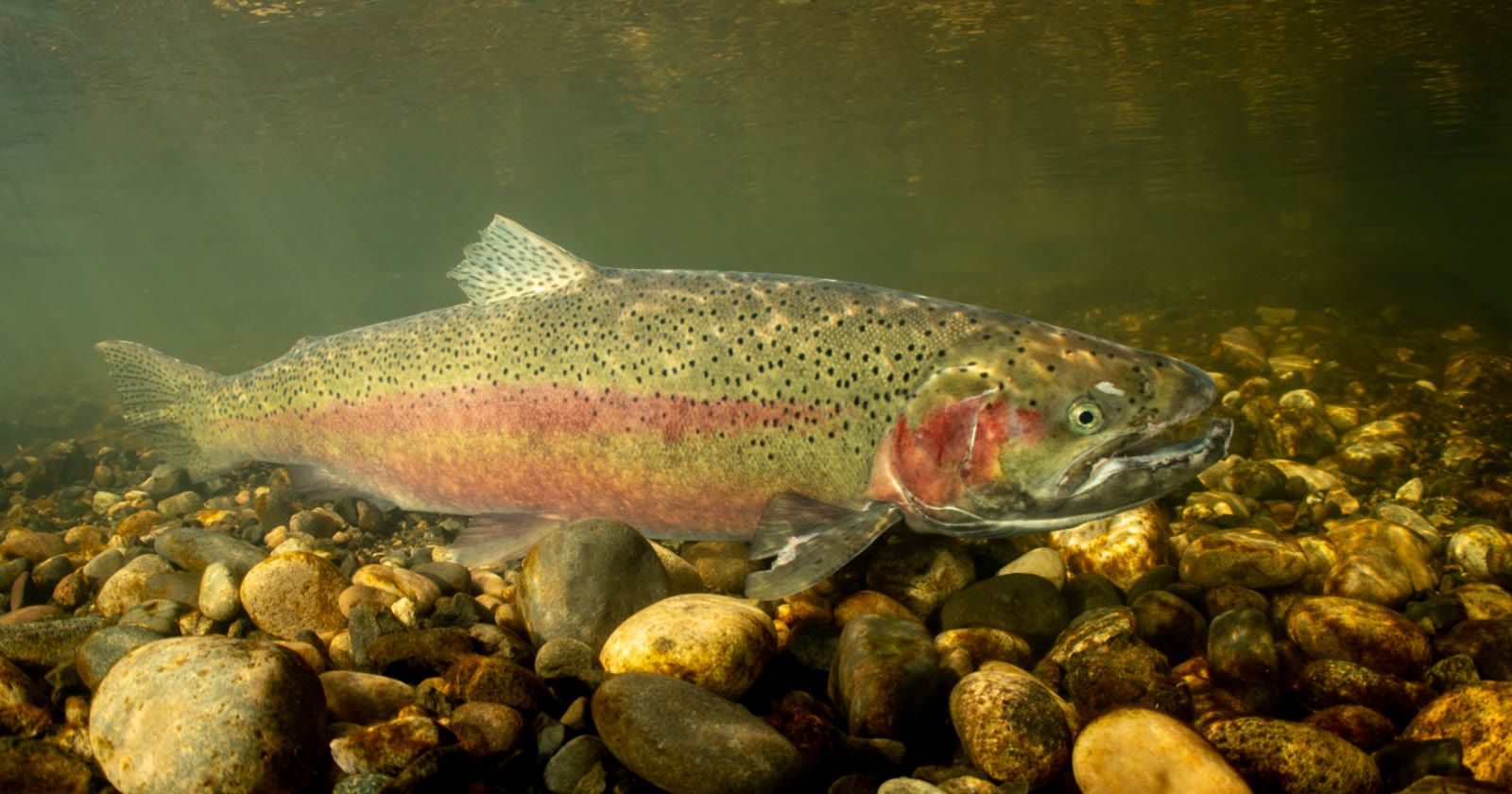
I was standing in a Michigan tributary in mid-November with a fish still in the net, gloves soaked, and a phone I did not want to uncover. The steelhead had moved up on the last rain. That is the whole problem with November steelhead fishing Michigan: the fish are in, the air is cold, and logging is the last thing your hands want to do. Do it anyway. The run only teaches you something if you can find the same water, flow, and presentation again.
Why November matters on Michigan steelhead water
Steelhead in the Great Lakes are migratory rainbow trout. They are born in rivers, spend most of their lives in the lake, and come back to spawn. Michigan DNR is plain about the calendar: lake steelhead enter their spawning streams from late October to early May. Many of those fish come in during the fall and overwinter in the river. They do not spawn until spring. Fall-run fish are typically the first to spawn, often in March, with spring-run fish following in April.
That is why November is not a leftover month. You are fishing fish that have already committed to the river, before ice and before the spawn, while they are still moving and holding. DNR also notes they do not necessarily die after spawning and may live to reproduce more than once. Handle a November fish as one you may see again in March.
I do not have a DNR temperature trigger to quote, and I will not invent one. What I watch is simpler: cooling water, a rain that bumps the river, and then the drop after the peak. Fresh fish use that rising and falling water to move. Once the bump is over, they slide into slower water along the way.
Check USGS real-time streamflow before you leave the driveway. I look at whether the river is rising, falling, or sitting still compared with the last few days — not at a magic cubic-foot number from a forum. Pair that with a thermometer in the river, not the air temperature on the truck radio.
Michigan's steelhead fishery is not a secret. DNR's Better Fishing Waters list names public rivers with steelhead, including the Pere Marquette, Little Manistee, Manistee below Tippy Dam, Muskegon, Betsie, and Bear Creek. Those are well-known public waters. I am not going to pin a hole, a tree, or a private stretch.
Where to look: runs, tailouts, seams, and below dams
Fall fish are traveling and then holding, not sitting on spawning gravel. I start in water that lets a chrome fish rest without fighting the whole river.
Runs with a walking pace of current and some depth are the first place I swing or drift. Tailouts — the last of a pool before it shallows and speeds up — are where fish often pause. Seams, where fast water meets slow, are travel lanes.
If the river is high and dirty, I fish closer to the bank and the slower inside bends. If it is low and clear, I stay back, lengthen the leader, and look for deeper slots with a roof of current over them. Fish also stack where they cannot go farther, which is why tailraces are crowded. DNR lists Manistee River below Tippy Dam among its better steelhead waters. Cover water, do not camp on someone else's float, and leave room at the next seam.
Log the stretch in your own words — "inside seam below the second riffle," not a pin you would regret posting. CastLog keeps spots private by default. That is table stakes. The useful part is the note you can read next November.
Presentations: spawn, beads, floats, and the swing
I carry a few ways to fish a November river and pick from the water in front of me, not from a favorite rod.
Drifting spawn or a yarn-and-egg imitation under a small split shot is the standard Midwest approach when you can bounce bottom without hanging every cast. If you are ticking rock every second, you are too heavy. If you never tick, you are over their heads.
Beads — a single bead pegged or fished near a hook — are the other drift. Michigan's Fishing Guide treats bead fishing as a lure: a bead on the hook, or pegged or attached no farther than four inches above the eye of a single-pointed hook, with that hook limited in gap. Read the current definition in the 2026 Michigan Fishing Regulations before you tie. On flies-only gear-restricted water, a bead is not a fly.
Float fishing covers a long run without grinding the bottom. A float holds bait in the lower third of the column through a seam you cannot wade. In colder, slower water, fish often slide out of the fastest slot into the cushion.
Swinging a fly or a small spoon is how I search, or how I fish when the water is clear enough that a dead-drift egg looks like what it is. Short casts, a downstream belly, a slow swing through the tailout. If a fish follows and does not take, I shorten the next swing rather than adding hardware.
On streams from August 1 through May 31, Michigan limits hook gap and lure weight. Drop-shotting — a weight hanging below a hook tied to the main line — is lawful on lakes and the Great Lakes, not on rivers and streams. Do not copy a lake rig onto a steelhead run.
I will not name a "best" color or a catch rate. What I log is which presentation moved a fish that day. Next week the river will be a different height. The note is the only thing that travels.
Cold-weather practicalities
Gloves are the whole game. I fish in something I can pinch line with. If I have to strip them to tie or to type, I stop logging, and then I stop remembering. Voice logging exists for this: say the catch with wet or gloved hands and put the phone away.
Ice in the guides is a real stop. I pinch it out rather than breathing on it until my glove is a skating rink. Fluorocarbon leaders get stiff; I carry a spare already tied.
Wading is slower in November. Rocks have algae and a film of ice at the edges. I use a staff in water I would skip in June. A rubber-bag net is easier on a cold fish than knotted mesh, and it lets you keep the fish in the water while you decide whether it is going in the box.
Phones die in the cold. Keep yours inside a jacket. If you are in a canyon stretch with no bars — and a lot of these rivers have those — the log still has to write. That is why I care about an offline fishing app more in November than in July.
License, Type waters, and the current Fishing Guide
Check the book. Seasons, gear, and possession rules are not the same from the mouth of a river to the first dam.
Michigan does not sell a separate trout or salmon stamp. The license page lists all-species licenses. The 2026 Fishing Guide says those licenses are good for all species allowed for harvest in the digest. If you are 17 or older, you need that license on public water. Carry it — paper or the DNR electronic copy — plus the ID you used to buy it.
What you still have to get right is the water type. Inland trout and salmon streams are mapped as Type 1 through 4, plus gear-restricted water and brook trout restoration areas. Inland trout and salmon maps color those reaches. Type 3 and Type 4 water is often open to fishing all year, but possession seasons, size limits, and rainbow (steelhead) exceptions change by reach. Gear-restricted water can be flies-only or artificial-lures-only. I am not going to paste bag limits here. They differ by river, and they change. Open the Guide and the map for the stretch you are standing in.
Great Lakes trout and salmon, including rainbow trout (steelhead), have their own table in the same Guide. A river mouth, a drowned river mouth, and the inland Type water above it are not automatically the same rule. Hook-gap limits, extra terminal-gear notes on named west-side rivers, and closures at ladders and lamprey weirs are in that digest too. Look it up the morning you go.
What to log, and why, with gloves still on
A November steelhead log is not a trophy shot. It is the conditions that put that fish in that lane.
I want these fields, every time:
- Clock time, not "afternoon"
- River and stretch in my own language, pin kept private
- Water temperature from the river, not the parking lot
- Flow or level — rising, falling, or the gauge reading if I have it
- Presentation: spawn, bead, float, swing, and where in the column it was
- The fish: steelhead or rainbow, rough length, chrome or dark, kept or released
Steelhead identification is not always obvious in stained water. DNR publishes a Great Lakes trout and salmon ID sheet. Mouth and gum color, tail spotting, and anal-fin ray counts are the useful checks. If you are unsure, snap a photo for Fish ID and do not stall the fish on the gravel while you argue about it. Catch-and-release handling still applies when the air is well below freezing.
CastLog is built for that net-still-in-the-water moment. Voice logging takes a sentence with gloves on. Manual logging is three taps, done in under five seconds. It writes locally if the canyon has no signal. Conditions can fill in so you are not thumbing a weather app with a wet index finger. If you also fish lakes this month, the same habit pays on late-fall walleye after turnover: time, temp, structure, and what you threw.
The payoff is next fall. After enough catches you are not guessing whether the float bite showed up on a falling river, or whether the swing only produced on the first day of a bump. You have your own week of November steelhead fishing Michigan, written down, private, and usable when the next rain hits.
If you have ever landed a November steelhead and skipped the log because you did not want to take your gloves off, that is the friction CastLog is for. Download it from castlogapp.com. Free core journal, voice logging and export. Angler Pro is optional, and a catch logs in seconds. On Android, drop your email for an invite. The run only helps you twice if you wrote it down the first time.